
How Traffic Warrants Work in Clark County
A citation is not a warrant on its own. Clark County's official traffic page states that no court appearance is required unless a driver contests a county citation. If the assigned date cannot be met, the page says another traffic date may be available within a 30-day grace period. During that stated window, the court does not issue an arrest warrant for failure to appear or failure to pay. That promise is narrow, though. It says nothing about a citation left unresolved after the window closes, and it does not reach a criminal charge, a town ordinance case, a commercial driver matter, or another court's docket. A missed date calls for a court check, not an assumption that a Clark County traffic warrant is active or inactive. Indiana public pages avoid the word "capias" here; the court's own wording is bench warrant or warrant for failure to appear, so use those terms when you call.
Clark County Citation Timeline
Clark County splits the life of a citation into stages: a new ticket, the assigned date, the limited grace period, and any later state notice. A fresh citation may take days to reach the payment system, and the clerk asks drivers to allow about five to seven days before checking Indiana ePay. Anyone contesting the ticket follows the court-date path instead.
- Read the citation for its court, date, and citation or cause information.
- Allow five to seven days for a new citation to appear online.
- Ask the traffic office about a later date within the stated 30-day grace period.
- Use an approved payment, deferral, or court route.
- Confirm any later docket or license status with its official custodian.
Commercial driver matters get no such grace and are fined by the court date in Clark County. Call ahead rather than relying on the general timeline.
Clark County Traffic Warrant Checks
Begin with Indiana MyCase, the public docket tool. Search by case number, citation number, cross-reference number, or allowed party fields. MyCase is not a live traffic-warrant index, but it may show failure to appear, an order, bond activity, or later action. The court itself must confirm current process. Then work every channel that fits. The Clark County traffic department takes questions at 812-285-6399 and traffic@clarkcounty.in.gov. The Clerk's main number is 812-285-6244. Clarksville Town Court handles its own matters at 812-283-1505. For sheriff-held service records, use the sheriff records route or call 812-283-4471. IDACS and NCIC stay restricted, and a records request recalls no warrant or extends no deadline.
Clark County ePay Route
The Clerk names the official Indiana ePay service as the online route. Clark County drivers should enter only the details the clerk and the citation supply, such as citation, UTT, or cause information. The form's fields change, so guess nothing. Enter details only at the source.
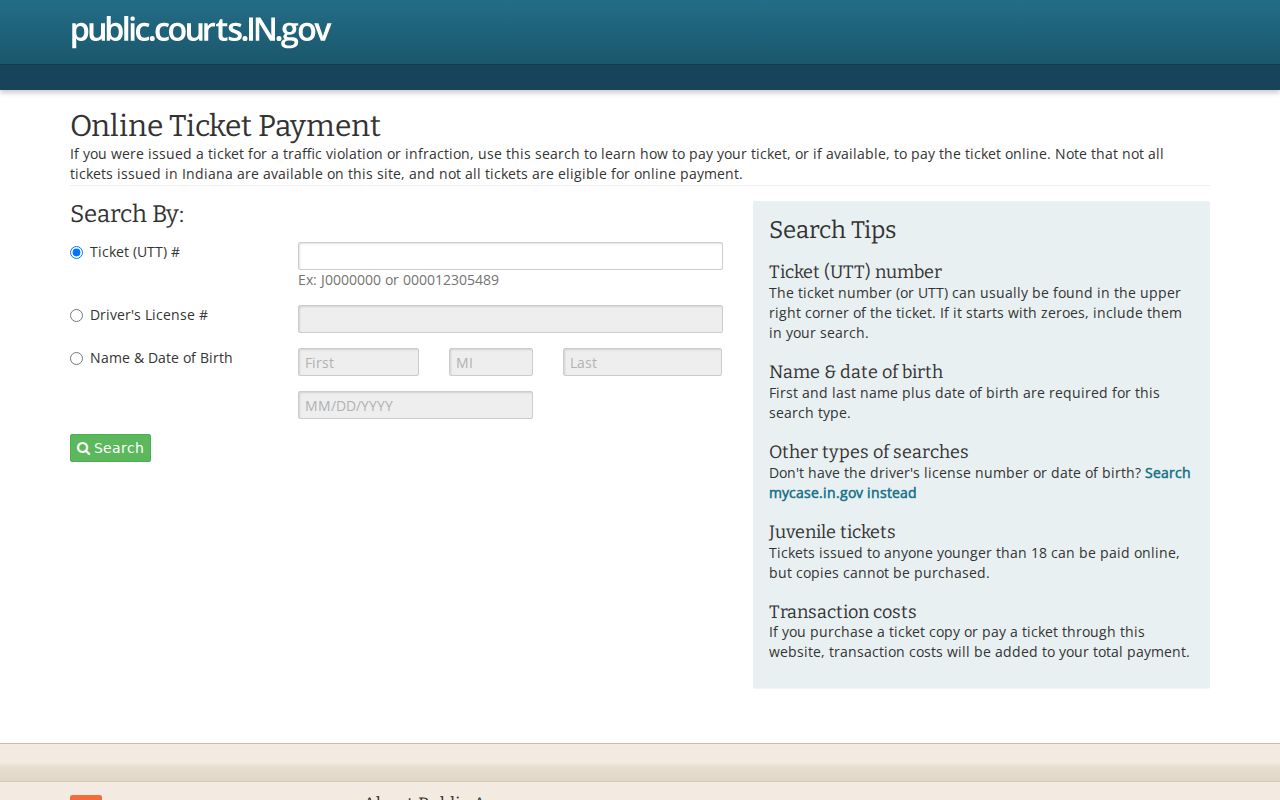
The service processes eligible payments. Paying there is not proof that every Clark County court or license issue has ended.
Traffic Warrants: What They Show
A public Clark County record may carry enough detail to identify the right traffic case. Fields vary by access level and court, and restricted information may be missing.
| Citation or UTT | The traffic identifier, illustrated as UTT-CLARK-00000, not an actual record. |
|---|---|
| Cause number | The court case identifier. |
| Issuing court | The court that controls process. |
| Event | A date, payment, FTA, or warrant-related entry. |
| Amount | A fine, cost, or balance in the official source. |
| Later status | Payment, recall, state notice, or another order. |
"Issued" does not mean served. "Paid" does not show that a later hearing or license step is complete, so ask the Clark County clerk about the latest order.
Clark County Payment Choices
The Clark County traffic page publishes the payment routes: online, in person, by mail, and by phone. Its current list covers several citation categories, though amounts can change. Personal checks are not accepted for the cited process, and card payments by phone can carry convenience fees. The page keeps those payment rules beside the court's warnings and contacts.
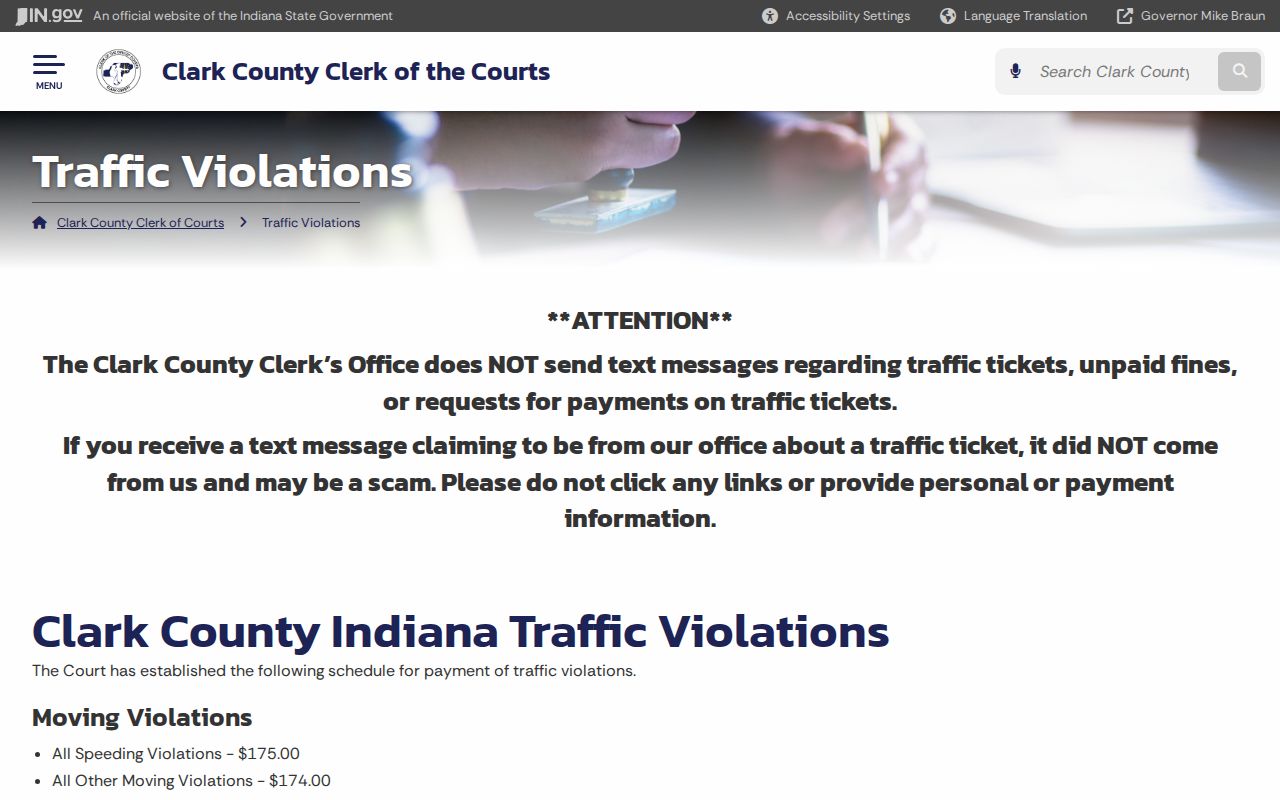
Follow the Clerk's current directions, never a link that arrives by text. Clark County warns that it does not send text messages about traffic tickets, unpaid fines, or payment requests.
Clearing a Clark County Traffic Warrant
Only the issuing court can recall, quash, withdraw, or change a Clark County traffic warrant. Recall means the authority withdrew process; quash means a judge set it aside. Assume neither from a receipt.
Safe next step: Confirm the court and cause number before paying, appearing, posting bond, or asking counsel to seek an order.
Ask the court whether payment is allowed, a new traffic date is open, an appearance is required, or counsel can act. If the court permits cash bond, the Clerk's bond page directs weekday payment to Room 137 at 501 E Court Avenue and gives an after-hours Watt Street route. Cash or cashier's check are the published methods. Not every Clark County traffic case needs bond. The Clark County city court warrant route explains local-court process.
Clark County Deferral Option
Clark County lets some drivers defer a traffic citation through its infraction-deferral program. The cost is $192.50 if accepted. Six months without another violation are required before dismissal. Finish clean and it is dismissed with no points. Eligibility is not automatic, though. Clark County excludes drivers with recent participation, a commercial or probationary licensing issue, no valid license, an already-paid citation, local ordinance matters, certain accident or school-bus facts, or pending criminal or probation matters. The prosecutor retains discretion. Submit the signed agreement with a copy of the ticket, attach a driving record if licensed out of state, and send no payment with the request. Allow up to two weeks for review; finishing deferral does not by itself prove a warrant was lifted.
How Traffic Warrants Trigger License Holds
Clark County notifies the BMV after 30 days of noncompliance. A license may then be suspended. Another state may be notified for an out-of-state license, and this court-to-licensing result is not proof that an arrest warrant arose on day 31.
| Issue | Official route | What it proves |
|---|---|---|
| Citation | Traffic clerk | Current court instructions |
| Docket event | MyCase and clerk | Public chronology |
| Noncompliance | Court and BMV | License-related status |
| Warrant entry | Issuing court | Process after confirmation |
Clark County sends BMV notice the next business day after payment. A suspension for driving while suspended or no financial responsibility may still remain after payment. Keep the receipt and confirm both systems.
Clark County Traffic Scam Check
A text demanding instant payment to stop a threatened arrest conflicts with the Clerk's warning in Clark County. Skip gift cards, cryptocurrency, wires, and unknown pages. Contact the traffic office through the official county page.
- Citation
- A traffic document, not automatically a warrant.
- FTA
- Failure to appear at a required event; the court decides the result.
- Noncompliance
- An unresolved duty that may lead to BMV notice.
- Recall
- An official withdrawal of process.
Write down the claimed court and cause number without sharing bank data. End the call, locate the official number, and verify. Call 911 only for an immediate emergency. Legitimate court work leaves a checkable trail. Compare the citation number, court name, and balance with the official Clark County traffic office. A threat that blocks independent verification is a warning sign. Never dial a number the sender gives. Find the county page yourself, then ask whether the case exists and whether any court process followed. If the answer concerns a license hold, ask which notice went to the BMV and what further confirmation is needed. If it concerns a warrant, ask which Clark County court issued it and what formal step can change it.